
For two years, we have supported an iconic French luxury brand in redesigning and modernizing its data ecosystem. This collaboration is part of a broader strategy to make data a central pillar for management and performance across all divisions of the house.
From streamlining data flows to designing actionable business indicators, we helped build solid technical foundations while embedding data at the heart of business processes.
Thanks to expertise that combines a deep understanding of operational challenges with technical rigor, we enabled data to become a common language between business and technical teams a true lever for decision-making and transformation within the house.
A French luxury house undergoing a data transformation
At the heart of the French luxury landscape, the house we support embodies the balance between artisanal heritage and innovation. Present in major international markets, it relies on exceptional know-how while seeking to enhance decision-making precision and responsiveness through data.
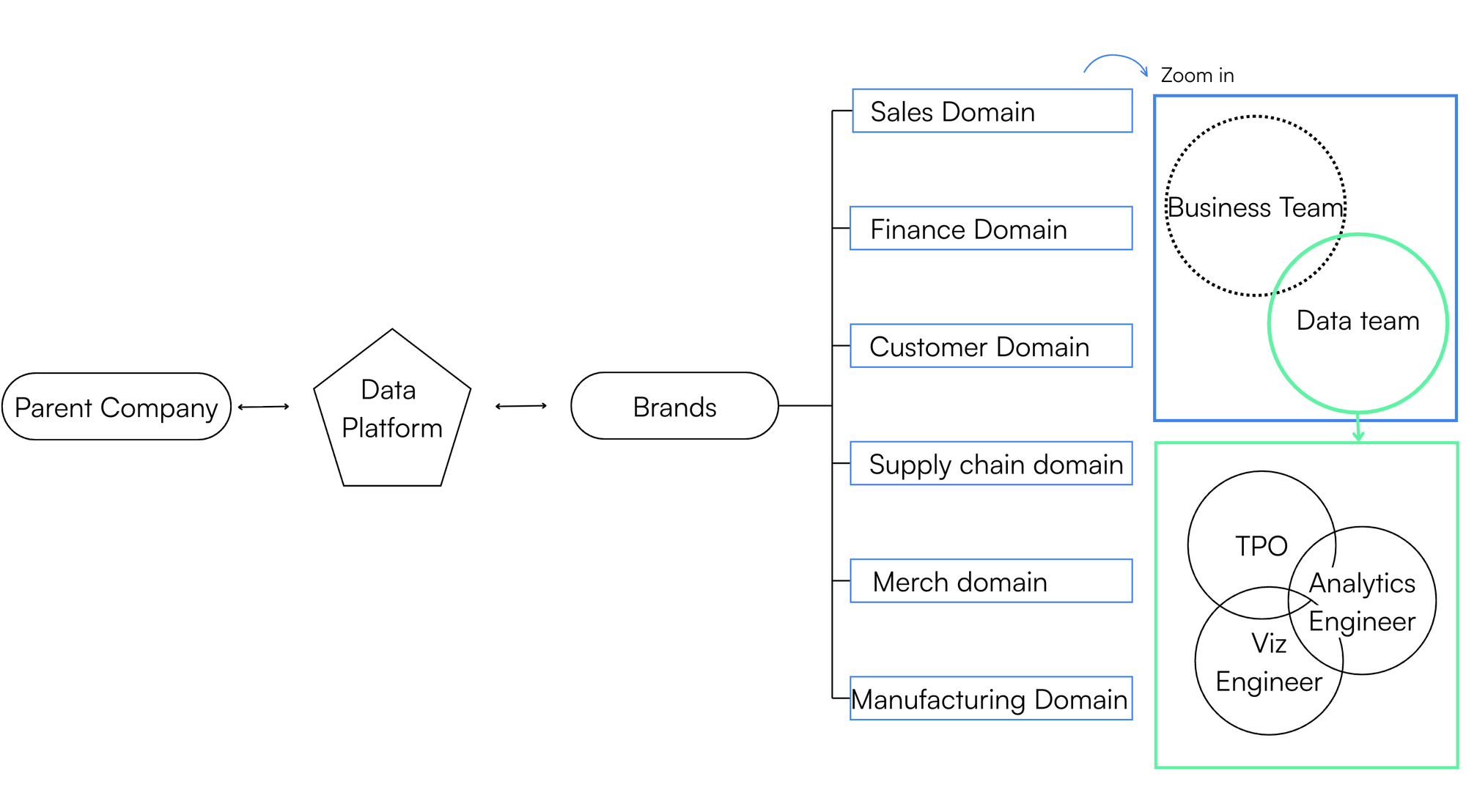
Like many players in the sector, it operates in a complex environment where multiple functions coexist: retail, e-commerce, digital, finance, supply chain, manufacturing, each producing and consuming data according to its own logic. To support this transformation, the house benefits from a shared Data Platform provided by its international group, centralizing data from key systems (ERP, CRM, e-commerce, finance, etc.).
Our role was not merely to ingest data, but to give it meaning and value: we aimed to transform a shared technical asset into a management and decision-making tool tailored to the realities and culture of a luxury brand. This mission sought to lay the foundations for unified, reliable, and sustainable data-driven management.
Structuring Data Management
At the start of the project, the house’s data function was only two years old. The initial technical foundations were in place, but practices, governance, and standards still needed to be structured to scale effectively.
Its ecosystem reflected the diversity of its business lines: multiple sources, no unified reference data, indicators calculated differently across teams, incomplete documentation, and a fragmented architecture. These were clear signs of an organization in development, ready to take the next step.
The challenge was therefore to build a robust and shared structure, enabling data to become a collective lever for performance and consistency.
Which structure to adopt for impactful data?
Our approach focused on four complementary objectives:
- Structuring governance and data domains to create reliable, documented, and shared reference data across all business lines.
- Developing data products tailored to use cases, designing indicators and dashboards aligned with business processes and decision-making needs.
- Modernizing and stabilizing existing systems, improving performance, reducing operational costs, and progressively migrating to the group’s Data Platform.
- Analyzing and mapping the data ecosystem to identify priorities, redundancies, and improvement opportunities.
These pillars laid the foundation for a structured and sustainable data function, where each technical product serves a clear business purpose for the teams. The following sections detail how this approach was implemented first through collaboration with business teams, then via the technical architecture supporting performance and reliability.
Co-Building a Solid Data Strategy with Business Teams
Understanding business needs to design useful data products
The success of a data project relies not only on technology but also on a deep understanding of business processes. For this luxury house, it was essential to first grasp the operational workflows and management rules specific to each domain sales, retail, digital, finance, supply chain, manufacturing, or product.
Before designing anything, we immersed ourselves in the data team and day-to-day business operations, mastering the objects managed, key indicators, and decision-making logics.
In a world where numerical precision supports creative excellence, every indicator has meaning: stock figures can reflect scarcity choices, margins depend on product positioning, and conversion rates reveal the strength of digital storytelling.
This detailed understanding allows for the design of truly useful data products that faithfully reflect operational reality while challenging the needs:
- Why this indicator?
- What decision does it inform?
- Is there a more reliable or relevant data source?
These exchanges foster a lasting partnership with business teams, turning data into a decision-making lever rather than a mere reporting tool.
Co-Creation and Design of Data Products
Once the needs were clear, we moved to scoping and design, following an agile (SCRUM) methodology.
Each product was co-created with business users, data analysts, and analytics engineers, following a product-oriented rather than project-oriented logic.
Scoping workshops explored two complementary dimensions:
- Functional, usage-focused: What is it for, who will use it, and what value does it bring?
- Technical, feasibility-focused: What data is available, at what frequency, and with what performance and cost constraints?
This dual approach ensures a balance between business ambition and technical sustainability.
During design, collaborative prototyping defines the indicators to expose, the level of granularity, and necessary filters. Visual validation workshops are conducted to adjust the final rendering before development.
Finally, each deliverable is designed as a reusable, evolving functional building block, following a product-oriented philosophy. This approach ensures longevity, maintainability, and continuous improvement as use cases evolve.
Data Governance, Sponsorship, and Adoption
Throughout the project, data governance played a central role, particularly in a context with multiple domains. Ensuring consistent indicators and reference data was key.
We worked to standardize management rules and establish common references, for example:
- When a commercial indicator is defined by the Sales team, it becomes the shared standard.
- When a product mapping or classification originates from Merchandising, it is adopted across other domains.
Such cross-domain coherence is not decreed; it is built collectively, balancing local and global perspectives and supporting a true cultural shift.
Success also relies on business sponsors, key figures in each domain who frame requirements, prioritize initiatives, and drive adoption within their teams.
By embedding data into daily workflows, they facilitated natural and lasting adoption, turning data into a common language between business units, management teams, and analysts.
Each product follows an agile lifecycle scoping, prototyping, development, and user testing supporting continuous adaptation and rapid delivery. By involving business teams, support functions, and leadership, this approach strengthens collaboration and aligns all stakeholders around a shared vision of reliable, performant, and sustainable data.
Technical Approach and Architecture of Our Data Transformation
How to leverage, reveal, and structure the potential of the Data Platform
When we joined the luxury house, its data ecosystem already relied on the group’s Data Platform, a robust technological foundation integrating:
- BigQuery as the primary data warehouse,
- dbt for modeling and testing,
- Airflow for orchestration,
- and a complete CI/CD and monitoring environment.
While technically mature, this setup was only partially exploited. Our mission was to unlock its potential: designing and developing data products that generate real business value, while building a scalable, modular, and governed architecture.
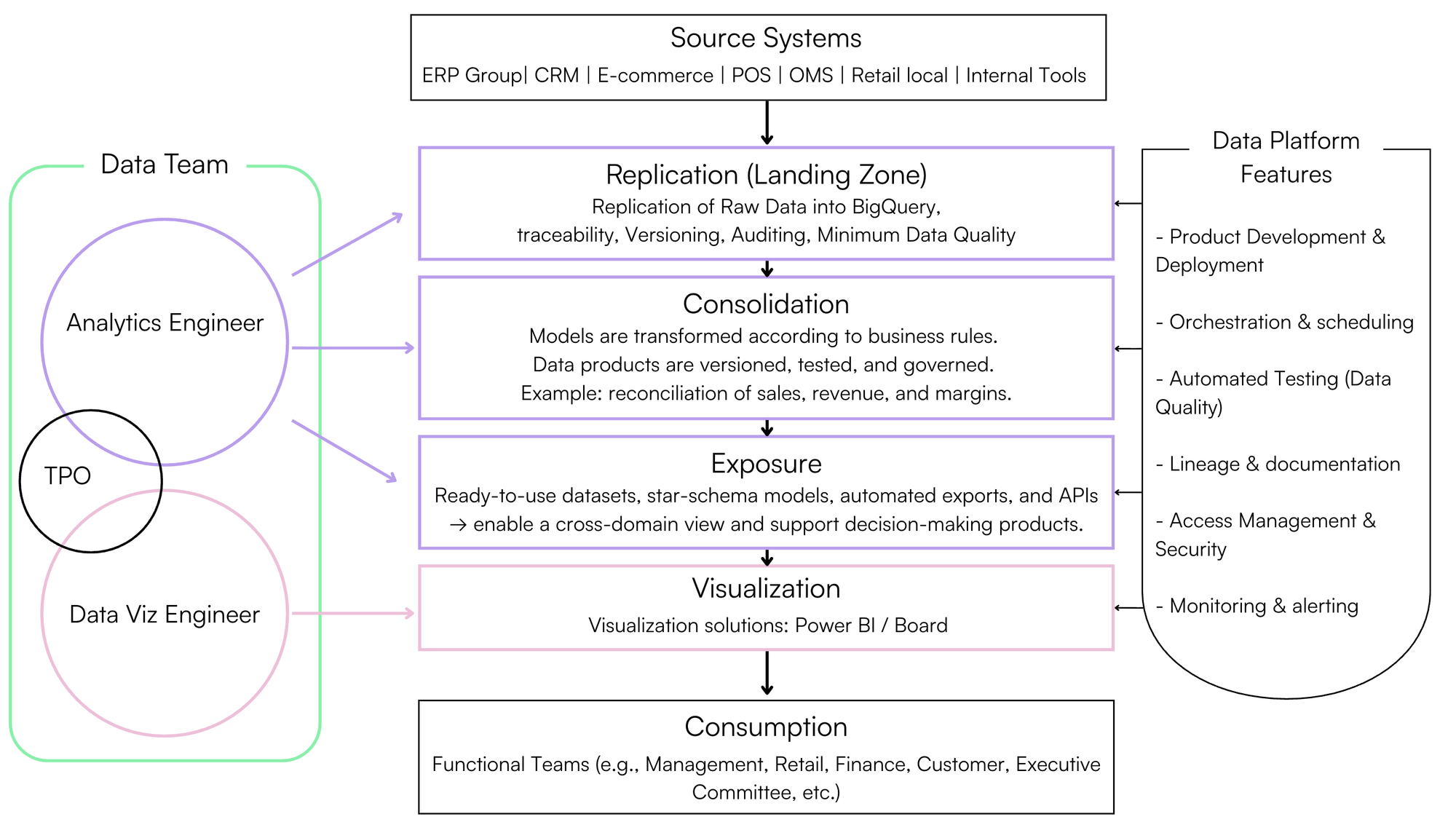
We consolidated the architecture into three main layers:
- Landing – governed raw data: Replication from group source systems ensures full traceability before any transformation.
- Consolidation – transforming data into reusable products: The core of the lineage, each product is an autonomous block defined by its inputs, outputs, orchestration, and contractual tests. Over 20 data products were developed, including:
- Sales reconciliation and planned sales,
- Customer behavioral modeling (recency, frequency, basket, typology),
- Retail/Digital alignment for an omnichannel view,
- Aggregation of cross-functional KPIs (revenue, volume, margin, conversion rate, product mix).
These products centralize complex calculations, ensure business consistency, and simplify downstream work.
- Exposure – data ready for use: Each product feeds users directly through Power BI datasets, automated exports, or self-service solutions. Models are built following BI best practices, ensuring robustness, performance, and reliability.
Modernization, Data Migration, and Cost Reduction
A key part of the project was modernizing existing data flows and gradually migrating from legacy systems to the group’s Data Platform.
Our legacy migration strategy:
- Step 1: Analyze and refactor historical code.
- Step 2: Conduct shadow testing to ensure no regression on critical KPIs.
- Step 3: Document and govern newly replicated sources.
This approach eliminated dependencies on unsupported systems and strengthened the technical foundations.
How we modernized the pipelines:
- Step 1: Improve BigQuery performance (partitioning, clustering, caching).
- Step 2: Redesign transformations for greater reusability and maintainability.
- Step 3: Standardize patterns and simplify calculations.
Organizing continuous optimization and monitoring:
Each product is tagged by domain for precise cost and performance tracking. Optimizations focus on materialization, temporal partitions, regular query reviews, and monitoring costly jobs.
Overall, this approach reduced costs, accelerated execution times, and enhanced the reliability of data processes.
A Reliable, Documented Data Transformation Driving Value
To ensure reliability and transparency during the client’s data transformation, we implemented a framework based on quality assurance standards. We built a data quality framework using reusable dbt macros, covering both technical tests (freshness, completeness, integrity, formats) and functional tests (Retail/Digital alignment, revenue/volume consistency, margin validation). Results are centralized in a monitoring dashboard with automated alerts and blocking mechanisms for impacted models.
We also documented each product exhaustively functional and technical descriptions, business rules, KPI mappings, ownership, and lineage diagrams synchronized between Confluence and dbt docs to ensure accessibility and traceability. On the security side, strict dev/prod separation, Git + CI/CD deployments, fine-grained dataset permissions, column masking, and full GDPR compliance were implemented.
Impacts and Results of Our Support
After two years of collaboration, the house now has a structured, performant, and widely adopted data ecosystem. Observed outcomes reflect both technical maturity and the teams’ ability to sustainably embrace new practices, delivering tangible improvements in performance and efficiency, technically and organizationally.
Data Reliability and Performance
- Modernizing architecture and processes significantly reduced BigQuery execution costs and pipeline runtimes through query optimization, materialization, and partitioning.
- Data orchestration shifted to an event-driven model, ensuring fresher, more actionable data.
- A data quality framework covered 25% of models with automated tests by the end of the engagement, enhancing platform reliability.
Data Industrialization and Reuse
- Over 20 data products and 10 business dashboards including 2 for the Executive Committee were delivered.
- Standardized and shared deliverables saved an estimated 10 FTEs per semester by reducing manual rework and improving indicator reliability.
- A centralized documentation repository (Confluence + dbt docs) halved onboarding time for new data team members.
Data Governance Adopted by Business Teams
- Shared governance connected eight business domains around harmonized indicators.
- Each domain now has roughly 60 active monthly users on Power BI, demonstrating growing adoption.
- This coherence relies on trained and committed business sponsors, ensuring continuity and propagation of best practices.
The house now has a reliable, governed, and business-oriented data foundation. Business teams access consolidated and shared indicators, supporting operational and strategic decision-making. Beyond technical results, this transformation strengthened cross-department collaboration and established a common data culture centered on reliability, transparency, and business value.